
Your brain already reacted before you finish reading this sentence.
A slight change in someone’s tone, a word that sounds harsher than expected, or a memory that briefly flashes in your mind and your body responds before you even realize it. Your heart may tense, your face may shift, or your thoughts may race. What feels like a conscious reaction often begins much earlier. In reality, many of our reactions are started by brain systems that work outside our awareness. Thinking does not always come first. Often, it steps in afterward to explain what has already happened.
Psychology explains this using what are called dual-process models of thinking. In the work of Daniel Kahneman, human thought is described as two systems working together. One system is fast, automatic, emotional, and intuitive. The other is slower, more deliberate, and analytical. The fast system does not pause to ask for approval. It constantly scans the environment for anything important possible danger, reward, something new, or social signals and forms quick judgments. The slower system, which depends heavily on the prefrontal cortex, comes in afterward to evaluate the situation, control impulses, or adjust the response if needed. This design developed through evolution because quick reactions increased chances of survival. A brain that stopped to carefully think before responding to threat would have been at a disadvantage in early human environments.
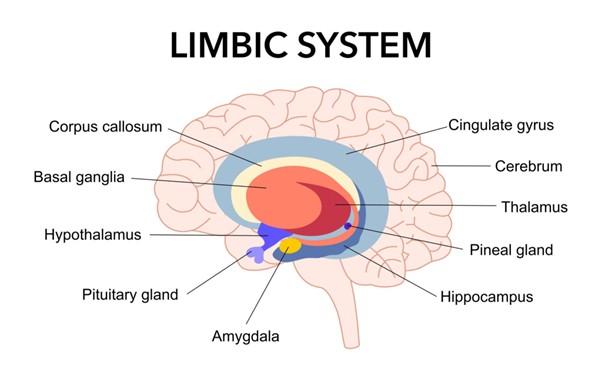
At the core of this fast emotional system is the amygdala, a small almond-shaped structure located deep within the brain’s temporal lobes.
Research led by neuroscientist Joseph LeDoux showed that sensory information can take a fast route in the brain, sometimes called the “low road.” In this pathway, signals travel quickly from the thalamus straight to the amygdala. This allows the brain to trigger physical reactions, such as a faster heartbeat, tightened muscles, or the release of stress hormones before the thinking parts of the brain fully process what is happening. Modern brain imaging studies continue to support this finding. They show that emotionally important stimuli can activate the amygdala within milliseconds, even when a person is not consciously aware of seeing them, such as briefly shown fearful faces. Simply put, the emotional brain responds before the rational brain has time to think things through.
More recent research adds further support to this idea. Studies that measure reaction times and use indirect (implicit) tests reveal that the brain can distinguish between emotions before people consciously report feeling them. Functional MRI scans show that parts of the prefrontal cortex can respond differently to emotional categories even when individuals say their experiences feel similar. This suggests that automatic and reflective processes happen at the same time rather than one after the other. The mind is not a single stream of thought; it is a network of systems working together at different speeds.
Importantly, these fast reactions are not limited to basic fear responses. Research in social neuroscience shows that learned factors, such as social identity, past experiences, or expectations can affect how quickly emotional information reaches awareness. Studies in affective science demonstrate that context changes the speed and intensity of unconscious emotional processing. This means our rapid reactions are shaped not only by biology but also by culture, learning, and memory. The brain creates an initial “first draft” of reality based on past experience long before conscious reasoning begins.
Although the amygdala is responsible for detecting emotional significance quickly, the prefrontal cortex located just behind the forehead plays an essential role in regulating and refining those reactions.
The prefrontal cortex helps you control impulses, make plans, think about right and wrong, and rethink situations in a more balanced way. But it needs time and energy to work properly. During sudden stress, hormones like cortisol can temporarily reduce how efficiently this part of the brain functions. When that happens, more emotional brain regions especially those in the limbic system take over. This is why strong emotions like anger, fear, or shame can narrow your focus and make clear thinking harder. The system has not broken down; it has simply been overtaken by faster emotional processes.
Your body is also deeply involved in this process. When something triggers you, your autonomic nervous system responds automatically. Your heart rate changes, your breathing shifts, and your muscles tighten often before you consciously recognize what you are feeling. Early psychologist William James suggested that these bodily changes are not just consequences of emotion but part of what creates the emotional experience itself. Modern research on interoception, the brain’s ability to sense internal bodily signals supports this view. Signals from your body help shape how emotions are formed and understood. Often, you notice the physical sensation before you can clearly name the feeling.
The idea that emotions can begin outside awareness is strongly supported by research. Experiments using very brief, hidden (subliminal) images show that people can react to emotional facial expressions even when they do not consciously see them. In affective neuroscience, researchers now speak of “unconscious emotional processing” rather than unconscious emotion. This means that parts of the emotional response happen outside awareness but still influence what you later experience consciously. Emotion is not a single moment; it is a chain of interacting processes unfolding over time.
From a biological perspective, these fast systems are highly useful. Automatic evaluation saves mental energy and allows quick decisions in uncertain or urgent situations. Without this efficiency, everyday functioning would be slow and exhausting. However, the same systems can also lead to biases or misunderstandings, especially in modern life where many “threats” are social rather than physical. A sarcastic remark or critical message can activate the same neural circuits that once responded to real physical danger.
The hopeful part is that the brain is plastic it can change. Research on emotion regulation shows that strategies like cognitive reappraisal, or simply naming what you feel (affect labeling), are linked to lower amygdala activity and stronger engagement of the prefrontal cortex. With repeated practice, the connections between emotional and regulatory systems become stronger. The fast-reacting parts of the brain can be influenced by the slower, reflective parts. Integration is biologically supported.
The parts of you that react before you think are not signs of weakness or lack of maturity. They are deeply rooted survival systems designed for protection and speed. Conscious thought is not the ruler of the mind; it joins the process slightly later. Psychological growth does not mean removing automatic reactions. It means strengthening the conversation between quick emotion and careful reasoning.
Your brain will always move faster than your thoughts. The question is not whether you react. It is whether, after the reaction, you allow reflection to join the conversation.
Speed may be automatic, but awareness is a choice.
Touch of Peace Mental Health Care Services Pvt. Ltd. Building an inclusive haven, where emotional well-being is woven into daily life.
Copyright © 2024 Touch Of Peace Care | Made With ❤️ Viba Digital Agency.