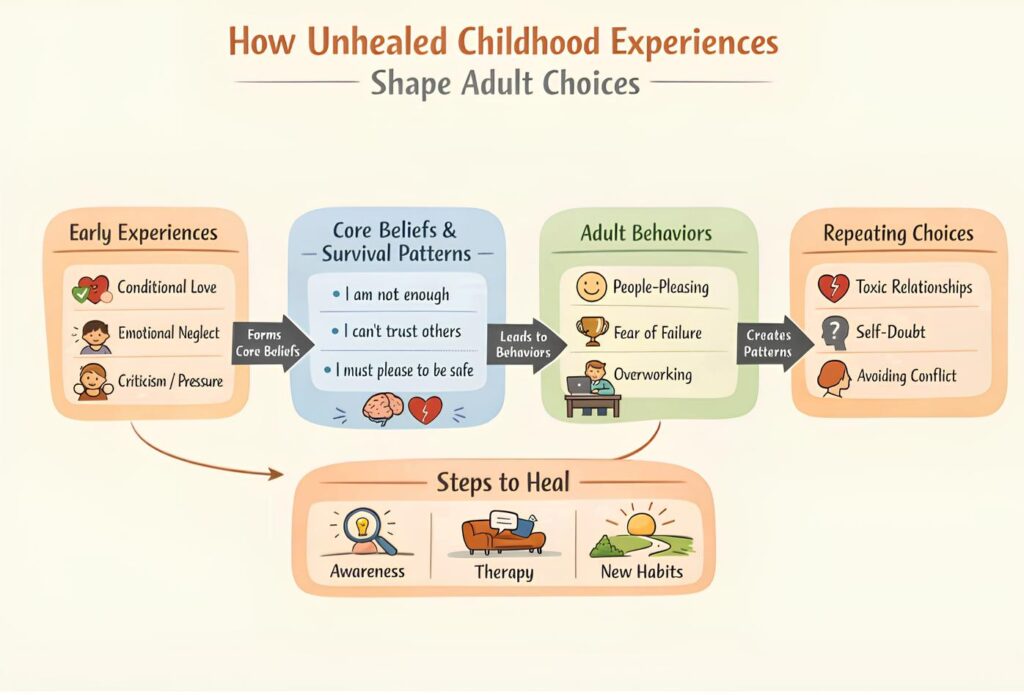
We often think we choose our life partner because of ‘chemistry’,Our jobs because of ‘interest’.But somewhere inside all of us, a small version is on the steering wheel – nodding or maybe panicking. Most of our adult decisions are not solely influenced by our interests, habits or likings. During childhood, our brain is coding – through repeated interactions with the environment, caregivers, the brain develops certain patterns which invisibly and quietly influence the choices or decisions we make as adults.
In the formative years, a child who experienced: Inconsistent or conditional love → Turns to become an adult who is hypervigilant to rejection
Shame or stringent punishment associated with mistakes → Becomes an adult who is easily paralysed by failures. This is what psychology calls neurodevelopmental conditioning.
Childhood is the time when the human mind is highly impressionable. Even long before language or logical thinking develops efficiently, we learn through our interactions with the environment – making sense of what the world looks and feels like! These early interactions, especially those with the caregivers help us form beliefs about safety, security and love – the foundational framework. A stable foundation develops when a child experiences warm relationships around, whereas the one who experiences inconsistent or dismissive relationships may grow into an adult who minimizes their needs, struggles to ask for help, or feels uncomfortable with emotional intimacy. These adaptations don’t disappear with age, rather become the patterns that shape the decisions and choices we make as adults.
From a psychological perspective, childhood experiences give rise to what are known as internal working models – deeply ingrained expectations about ourselves and others. Some of the traits that we identify as our personality frameworks are, in fact, defense mechanisms developed early in life for adaptation to a stressful situation. As children, these strategies appear adaptive and protective. As adults, when left unexamined, they become exhausting or limiting.
One of the strange outcomes of such unhealed childhood experiences is repeating the emotional patterns even if they are painful. As adults, we may be drawn to engage in situations that are emotionally exhausting, resembling the patterns of early childhood dynamics – emotionally unavailable figures, unstable environments, dominating figures. A point worth considering here is that such choices may not be conscious, but a result of neural patterns where the brain is wired to seek familiarity. Thus, as a result people may confuse emotional exertion with intensity and chaos with passion.
Many of the responses that we consider ordinarily behavioral are indeed influenced by our emotional patterns developed during childhood. For instance, emotional responses such as crying in the middle of a fight, experiencing intense anxiety during a conflict or overwhelming sense of guilt when prioritising self. The adult mind may feel that the present is safe, however the childhood experiences subconsciously lead the body to react in a way as if the past is repeating. The consequent disconnect is why insight alone fails to produce change.
The question is: How can we become aware of such childhood patterns and heal ourselves internally?
Firstly, the process of healing doesn’t base itself on blaming someone or reliving the past endlessly. The foremost task is to become aware of these internal patterns and gently question if such patterns are still relevant to adaptation.When individuals recognize that a present reaction belongs to an earlier version of themselves, they create space for choice.
Various techniques such as emotionally stable relationships, seeking therapy, self-reflection may help
us in revising and correcting these patterns.
Ultimately, adulthood is not defined by age but by agency. When unhealed childhood experiences remain unconscious, they govern decisions from the background. When they are acknowledged and understood, individuals gain the freedom to respond rather than react. In that awareness lies the possibility of living not from old wounds, but from present choice.