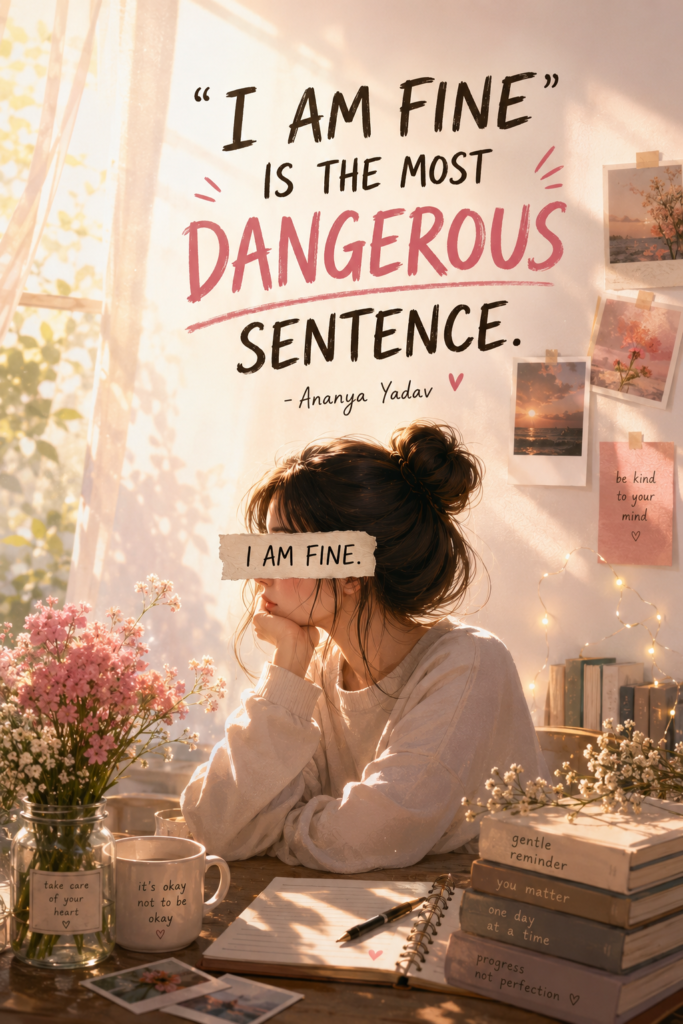
“I am fine.”
Same answer, different mouths, it remains the same.
This is my story that I want share with all those who read, from my mom who genuinely cares about me to a random stranger who accidently saw me crying in the backseat of the bus asked, “Are you okay?” And always the answer is the same, “I AM FINE.”
Not sad even though I have never sobbed bad enough,
Not anxious even though I am shaking,
Not happy even though I haven’t been genuinely happy for days now,
Not even okay.
Just fine, like hanging somewhere in the middle, somewhere, hopeless, that’s what it felt like to me.
The kind of line that we generally type and say without emotion, without punctuation, without truth.
And the next day, I show up looking perfect, smiling, confident, making everyone around me smile and laugh, but deep down at one point I guess I stopped processing my own emotions, they became a hassle, all to make it seem like I am perfectly fine.
Psychology and researches have shown- the people who say ‘I am fine’ the most are the once fighting the hardest battles internally.
Why?
Because I am fine, somewhere along the way, became a sentence that is socially rewarded.
It ends the conversations quickly, it prevents vulnerability, it protects from discomfort.
It makes pain invisible.
Research reveals that humans showcase something known as emotional masking, the suppression or concealment of genuine emotional states to meet social expectations. The studies of psychologist James Gross on emotional regulation found that emotional suppression is linked with increased physiological stress, anxiety, depressive symptoms, and poorer interpersonal functioning.
Basically, pretending to be okay does not make the pain disappear it makes it heavier, the body keeps score even when the mouth says ‘fine.’
One of the biggest myths about mental health, is mental health must look dramatic, but many people experiencing anxiety or depression continue functioning externally. They go to college, attend meetings, cook meals, reply to texts, laugh at memes, this phenomenon is often referred to as high functioning depression or smiling depression, not an official diagnosis, but clinically recognized patterns where individuals maintain outward functionality while internally struggling with hopelessness, fatigue and emotional numbness.
A 2018 study published in frontiers of psychology found that individuals who habitually conceal distress often report higher loneliness and lower perceived social support even when surrounded by people.
Because hiding pain creates isolation.
Nobody can support a version of you that they never got to meet.
Sometimes fine can mean, “I don’t want to ruin the mood”, “you probably won’t understand”, “I am tired of being vulnerable”, and the saddest might be, “I have said it so many times that even I have started believing it.”
Social media platforms like Instagram, intensify this problem, we perform aesthetic routines, productivity videos, motivational campaigns, filtered and properly edited happiness, yet the global loneliness statistics continue to rise.
Harvard’s long running study adult development study- one of the longest studies on human happiness found that the quality of close relationships is one of the strongest predictors of emotional well being and longevity, not achievement, not money, not perfection.
Connection.
Real connection requires emotional honesty, and honesty begins when we stop weaponizing the phrase “I am fine” against ourselves.
Human beings are not machines designed for constant emotional performance, pain need language, grief needs witness, exhaustion needs rest, and people need people.
I kept saying I was fine because I thought if I said it enough, maybe it would become true. But so many people are doing the same as me, and I was so wrong, because smiling through burnout, functioning through depression, surviving through silence, and being rewarded by how quietly we take on the challenges, is so emotionally exhausting, I have decided to become a little selfish, and so should you, so the next time someone says “are you okay?”, I will be brave enough to start with something like, “I have been overwhelmed lately. Can you sit with me for some time?”, it might be small step, but from my experience with my own emotions and those of others, I know sometimes people who need help are the one who have mastered sounding okay.
So, I’ll be brave, and say, “Maybe I am not.”