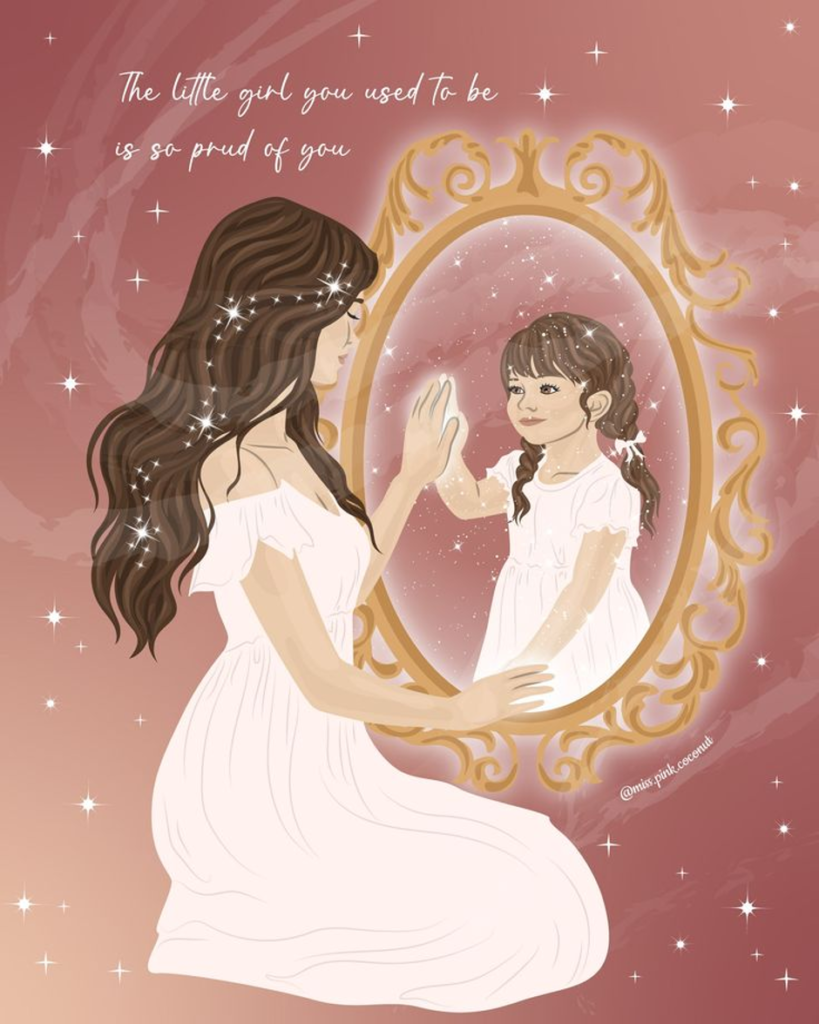
There is a very cliché phrase that I think mostly every person has heard once in their lifetime,
that a girl finds her dad’s image in her future partner and boy would want someone who
resembles his mom, as stupid as it sounds, I am not targeting towards the Oedipus complex
nor the Electra complex, proposed by Freud, nor do I mean to promote it, but there is some
uncanny similarities that link your childhood experiences to your adult relationships, well
how? let’s take some more questions, have you ever wondered why some people trust others
easily while others have their defences up at all times? Why does someone find it easy to
communicate what they are feeling while others completely withdraw? And why do certain
relationship patterns seem repetitive, even when we consciously want something different?
Our first experience of any relationship happens during our childhood, before we even know
what a romantic relationship is, we understand what closeness is, how emotions are
expressed, how conflict is handled, and whether the people we depend on are likely to be
available when we need them. These early experiences don’t determine exactly who we
become or whom we love, what they do contribute however is the expectations or behaviours
we have from our partners later in life.
For a child, caregivers are not simply people who provide food, shelter and protection but
also people who become important sources of emotional information.
Through repeated interaction, children experience responses to their needs, emotions,
mistakes, distress and attempts to seek comfort. Over time, these experiences can contribute
to expectations about relationship and emotional closeness.
A systematic revies by River et al. (2022), which examined 40 studies, found evidence
linking parent child relationship quality, including attachment security and the quality of
parent child interactions with later romantic relationship functioning. The associations were
particularly evident in areas such as romantic relationship adjustment and observed
interaction between romantic partners.
This does not mean a child simply copies their parents. Instead, early relationships may
contribute to developing ways of understanding and responding to interpersonal situations.
A child who repeatedly experiences responsive caregiving may develop expectations that
other people can be available or supportive. Conversely, experiences of rejection,
inconsistency or emotional unavailability may contribute to uncertainty about whether
closeness is safe or whether one’s needs will be met.
These are tendencies not permanent rules.
Lets take the story of a boy and girl, the boy grows up in a household where there was a strict
patriarchal system and boys were supposed to stay something along the lines, “boys don’t cry,
my strong baby, come on stop crying” so the boy, Rohan, grows up without knowing how
express emotions, as a child whatever he ever wanted was given to him, without ever asking
twice, he was a single child and was spoiled from childhood, as Rohan grew up, he meets a
girl, the girl comes from a humble background, is the eldest child out of four siblings, has
grown up on the lines, “you are the eldest so give it to your younger”, “you are so reliable”,
“my smart daughter, you are such a role model for your younger siblings”, so the girl grew up
to be a overachiever, and a hyper-independent individual, who was never given the chance to
behave her age as she was “reliable”(pun intended), well the girl, Aleena, falls for the boy
too, and then after sometime (a lot of time) they get married, congratulations to them, but
what do you think their married life would look like?
One of the most influential psychological frameworks for understanding this process is the
attachment theory, it concerns how people experience and regulate closeness, dependence,
security, and separation in important relationships. A 2026 three-level meta-analysis
examined 211 studies, in which 228 independent samples, and there were 82,376 participants.
It found that childhood mal-treatment was associated with both greater attachment anxiety (r
= .23) and greater attachment avoidance (r = .20) in adulthood. The associations were
stronger for emotional mal-treatment.
Attachment anxiety can involve heightened concern about rejection or abandonment, whereas
attachment avoidance can involve discomfort with emotional dependence or intimacy.
The connection between childhood experiences and adult relationships becomes particularly
clear when we look at childhood emotional mal- treatment.
A three-level meta-analysis involving 201 effect sizes from 23 reports conducted by Cao et
al. (2022), found statistically significant but modest negative association between childhood
maltreatment and romantic relationship well-being in adulthood (r= -.143). The association
was stronger for negative relationship outcomes than for positive ones. This finding became
important because it changes two extremes, “childhood doesn’t matter once you became an
adult.” And “your childhood determines every relationship you will ever have.”
Research
doesn’t support the latter either. The evidence falls somewhere in between: childhood
experiences can influence later relationship functioning, but they are only one part of a much
larger developmental picture.
Relationships are not just made of affection and closeness. They involve disagreement,
frustration, boundaries, repair and communication.
Children OBSERVE, how important adults around them deal with conflicts.
Longitudinal researches have examined whether patterns of family interaction during
adolescence are associated with patterns of interaction in romantic relationships later in life.
Such findings suggest that the aspects of family interaction can show continuity into adult
relationships.
This doesn’t mean that someone who grew around conflict Is destined to recreate it. It means
that early interpersonal environments may provide experiences from which people develop
expectations and behavioural strategies.
A child may, grow up believing that conflict is something that can be discussed and repaired.
Another may repeatedly observe conflict followed by silence, withdrawal, or hostility.
Years later, these experiences may influence what feels familiar in an intimate relationship.
And sometimes, what feels familiar can be mistaken for what feels normal.
Perhaps the rightest way to explain the relationship between childhood and adult relationships
is not:
“Your childhood determines your relationships”
Rather:
“your childhood may influence the expectations and patterns you bring into the relationships,
but your later experiences can influence them too”
The first relationship we experience can become an early reference point for understanding
closeness, trust, conflict, and emotional safety. Research consistently suggests that early
relational experiences are associated with later interpersonal and romantic functioning.
But association is not destiny.
We simply not are repetitions of our childhood.
Sometimes understanding where the pattern first began is the first step towards deciding
whether we want to continue it.
And perhaps that is the most hopeful part of developmental psychology: the past can help
explain the pattern without having the final say in what happens next.
Lets come again to Rohan and Aleena’s story, because that is not how their story ends,
Because childhood can influence relationships in adult life and not determine them.
Rohan learns that expressing sadness does not make him weak, he learns to say, “I’m hurt”,
instead of becoming silent.
Aleena learns that being independent does not mean she has to carry everything alone, she
learns to ask, “can you take care of this for me?” without feeling irresponsible.
And, perhaps, most importantly, they can learn that love is not simply about finding someone
who fits the patterns we grew up with.
Sometimes a healthy relationship asks us to unlearn them.
Their childhood may have brought them to the relationship.
But what they do with those patterns once they become aware of them is what shapes where
the relationship goes next.